
Consultations and follow-ups are free
Some of the pages you will find for Ultherapy in London call it a "non-surgical facelift", say results can last two years, or leave out the contraindications and the risks that the manufacturer's label lists. This guide is written by the team that runs Ultherapy at our clinic in the Harley Street medical district and reviewed by our clinician. It gives you the numbers from the actual studies and the manufacturer's own label, the real London prices, and the honest answer to who it is not for.
What Ultherapy is
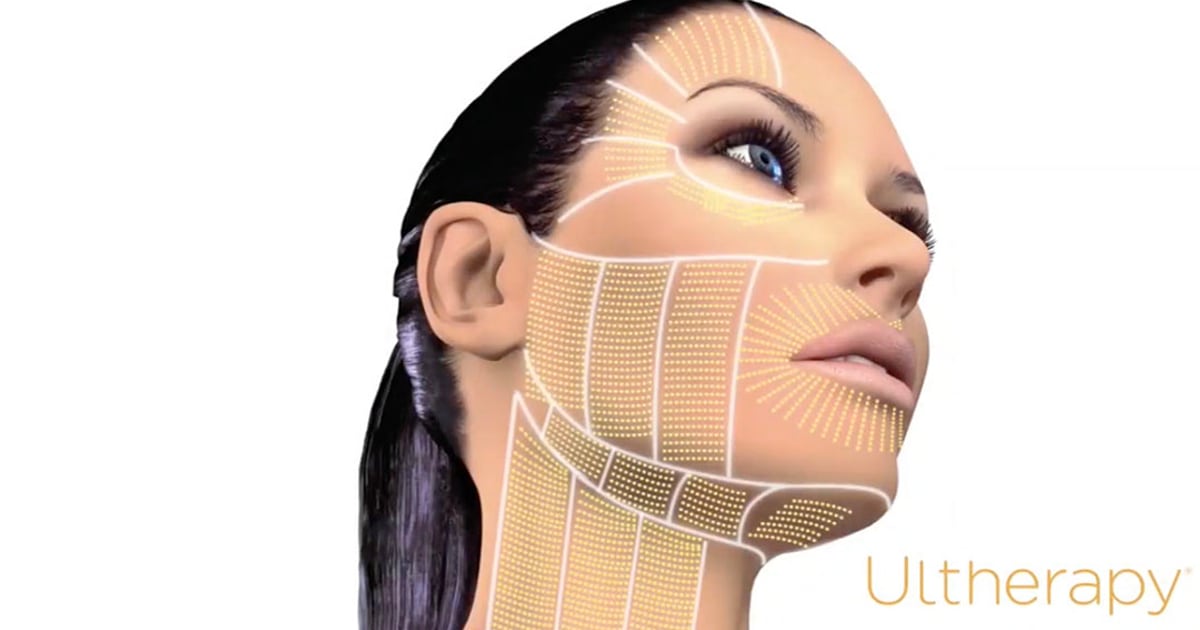
Ultherapy is a treatment made by Merz Aesthetics. The device delivers micro-focused ultrasound. A transducer held on the skin sends sound energy to one tiny point under the surface, where it heats the tissue to around 65 degrees for a fraction of a second. According to the manufacturer's label each point of coagulation is smaller than a cubic millimetre. The skin surface is not the target of the energy. Each line is made of many points, and a full session lays down hundreds of lines. Over the following months the body's healing response produces new collagen, which is how the lift is thought to build.
Three focal depths are used, listed in the manufacturer's labelling as 4.5 mm, 3.0 mm and 1.5 mm. Published papers describe these as reaching the deeper layers, the deep skin and the upper skin. Each depth has its own transducers, and a full face and neck session typically runs several hundred lines; published figures range from about 300 to 800.
One feature of Ultherapy that we value is the imaging. Before each line the clinician sees an ultrasound picture of the tissue to a depth of 8 mm on the console, called DeepSEE. In the US regulator's wording the imaging is cleared to confirm the transducer is coupled to the skin and that the energy is going to the right depth and not into bone. In practice it means the clinician can check the coupling and the depth on screen before each line, which is a safeguard, not a promise.
Does Ultherapy actually work?
For the right face, yes, and the honest version is more useful than the marketing one.
- In a 2010 trial (Alam, industry-funded), 30 of 35 people evaluated, 86%, were judged by three masked raters to show a clinically significant brow lift at 90 days, with an average brow elevation of 1.7 mm.
- In the study submitted to the US regulator for the neck and under-chin clearance (open-label, 70 people), 51 met the threshold for a lift; of those 51, 84.3% were rated improved by masked evaluators. You will see "84% improved" on clinic pages; the figure applies to the responders, not to everyone treated.
- In a 2014 prospective trial (Oni, 93 people evaluated), blinded reviewers saw improvement in skin laxity in 58% of people, while 66% of patients saw it themselves. People with a body mass index over 30 did much worse in that trial: more than half showed no change.
- A 2025 meta-analysis of 42 studies put investigator-rated improvement at 89% and patient-rated improvement at 84%. Satisfaction fell from 84% to 62% when the questionnaire offered a neutral answer, most studies had no control group, and about four in five followed people for six months or less.
So the realistic picture is a visible but moderate lift in most people with mild to moderate laxity: in a 2023 review, investigators rated the result "mild" or "moderate" far more often than "significant". It is not surgery and it does not pretend to be.
What Ultherapy does well:
- Lifting a brow that has started to drop and opening the eye area.
- Tightening the skin under the chin and the neck, which is the cleared indication; some studies also report firmer skin along the jawline, which is not a cleared indication.
- Softening the lines on the chest (décolletage), which is a wrinkle indication rather than a lift.
What Ultherapy does not do:
- It does not remove fat. A full double chin is a fat problem first and a skin problem second.
- It does not replace a facelift. If the skin at your jaw hangs in a fold, you are past what ultrasound can do and we will say so.
- It does not add volume to hollow cheeks, and it does not relax expression lines the way a toxin does.
Who Ultherapy suits, and who it does not
In our experience the best candidates are people from their late thirties to their sixties with mild to moderate laxity, a body mass index of 30 or under, and realistic expectations. The label covers adults of any gender, though most studies were in women. The manufacturer's label covers all skin types; published outcome data in the darkest skin types are thin, so if your skin is very dark we discuss it rather than assume.
The manufacturer's label lists these as contraindications, and a reputable clinic will ask before booking you:
- Open wounds or lesions in the treatment area.
- Severe or cystic acne in the treatment area.
- An active implanted device such as a pacemaker or defibrillator, or metal implants in the treatment area.
The label also says the device is not recommended directly over mechanical implants, dermal fillers or breast implants, or directly on an existing keloid, and that it has not been evaluated in people on anticoagulants. The label says it should not be used on the eyes, over the eyelids or within the orbital rim, and that the thyroid, major vessels and nerves should be avoided.
The label says the device has not been evaluated in these groups, which is not the same as being forbidden. They are: pregnant or breastfeeding women, children, people with a bleeding disorder, an active skin disease that may alter wound healing, herpes simplex, autoimmune disease, diabetes, epilepsy or Bell's palsy. Bring your history to the consultation and the clinician decides case by case. In pregnancy and breastfeeding we do not treat.
We do not offer Botox or dermal fillers. Our clinic works with your own collagen and muscle, and Ultherapy fits that: nothing is injected and nothing foreign stays in the face. If you have had injectables elsewhere they are not a barrier. The manufacturer's instructions set no waiting period; our own protocol is to leave two weeks after a toxin and four weeks after filler before an Ultherapy session, and not to treat directly over filler.
Not sure you are suitable? Ask the clinician, it is free
What a session is like, step by step
- Consultation. The clinician looks at your face and neck at rest and moving, checks the list above, and agrees the areas: brow, lower face and under the chin, neck, décolletage, or a combination. Consultations and follow-up reviews are free.
- Preparation. Photographs, then the treatment areas are marked out with a grid. A numbing cream or a simple oral painkiller is offered; the manufacturer does not prescribe one, and we set it with you. Ultrasound gel goes on.
- Imaging and treatment. For each line the clinician places the transducer, checks the image on the screen, then delivers the energy. You feel a brief deep heat and a prickle as each line is laid, strongest over bone. In the studies people rate it around 4 to 6 out of 10 on average; discomfort can linger for hours and tenderness can last days to two weeks. The energy level can be turned down if you need it.
- Time. In our experience a full face and neck takes about 60 to 90 minutes, and a brow or a décolletage alone about 30 minutes.
- After. The gel comes off and you go home. Expect pinkness for a few hours and some tenderness that can last from days up to two weeks. Makeup can go on the next day.
How many sessions, when you see the result, how long it lasts
| Feature | What to expect |
|---|---|
| Sessions | One. Merz says a single treatment is usually all that is needed, and the pivotal studies are single-treatment. One 2017 study's authors suggest a repeat can be considered three months later, and some people with more laxity choose that |
| First change | Some people notice a tighter look within days, partly from swelling; do not judge the result on it |
| Main result | Measured at 90 days in most studies and still building to 3 to 6 months |
| Peak | Clinicians commonly describe the result building for three to six months; no controlled study has pinned down when the peak is |
| How long it lasts | Merz says "a year or more". The longest studies we found follow people for one year; in one of them, only 6 of 14 people were rated improved by blinded assessors at that point. In our experience the lift lasts around 12 months in most faces. One objective study in 25 Taiwanese patients found the brow lift had faded by six months, so individual variation is real |
| Maintenance | There is no published repeat schedule. In our experience people who want to maintain the result come back after about 12 to 18 months, once the lift has faded |
Several things affect how much lift you get, including the number of lines placed, your skin laxity, your body mass index and your own collagen response, which nobody can measure in advance. In our experience the people who are disappointed are almost always the ones who were sold a facelift.
What Ultherapy costs in London
Ultherapy is priced per area and the cost is driven by the number of transducer lines, because each transducer has a fixed cost. Among the London clinics whose pages we read in , only one publishes a full price list: a brow from about £400, the neck alone about £1,700, the décolletage about £900, a full face about £2,600 and a full face and neck about £3,300. Two central London clinics advertise "from £800" as an entry price without saying which area, and a third quotes a span of £500 for a small area to over £4,000 for a full face and neck. Several top-ranking clinics publish no price at all.
At our clinic the price depends on the areas you treat and the lines they need, so we quote it in writing at the free consultation, after we have looked at your face and not before. We price match any comparable written quote. Interest-free finance through Humm is available, subject to status, with terms that depend on the amount. We run offers from time to time, and the consultation and every follow-up review are free whatever you decide.
A warning on cheap sessions. An ultrasound "lift" offered at a few hundred pounds for a whole face may be a different device sold under the Ultherapy name, or a session with far fewer lines than the protocol calls for. Ask what machine it is, how many lines you are getting, and who is holding the transducer.
Consultations and follow-ups are free
Results you can check
The before and after photographs on some of the Ultherapy pages we reviewed are undated and unlabelled, and some are the manufacturer's. At your consultation the clinician shows you photographs of our own patients, matched to your face and your concern, with their consent, and you can compare them with your own photographs at three months. We do not publish them here.
Patients have reviewed the clinic on review.clinic, where Ultherapy at our clinic holds 4.9 out of 5 from 49 reviews, with 100% saying the treatment was worth it (). Read the ones that mention the jawline and the neck; they are the most useful.
Ultherapy PRIME: what changed and what did not
Ultherapy PRIME is the current console, launched in the US in and announced for the UK in . According to the US regulator's summary it is a console update: a larger screen, a modern operating system, new software and, in later releases, a treatment-planning mode and clearances for the abdomen, the arms and the knees. The ultrasound energy and the treatment guidelines are the same as the previous system. Merz says PRIME treatments are about 20% faster and the screen 35% larger; those are the company's figures. There is no clinical trial showing that PRIME gives a better or a more comfortable result than the original, and a clinic that tells you otherwise has no published trial behind the claim.
The question to ask is not "is it PRIME" but "is it a genuine Merz Ultherapy system, with the imaging on, and a genuine, in-date Merz transducer". In Merz warned in Hong Kong and Macau about counterfeit and refurbished transducers that can deliver inaccurate energy; we found no such notice from the US FDA or the MHRA. Our clinic treats with a genuine Merz Ultherapy system and the clinician shows you the tissue on screen before the first line.
Ultherapy compared with the alternatives
| Feature | Ultherapy | Sofwave | Morpheus8 | EMface |
|---|---|---|---|---|
| Energy | Focused ultrasound, 1.5, 3.0 and 4.5 mm | Ultrasound, 1 to 2 mm | Radiofrequency through microneedles | Radiofrequency plus muscle stimulation, no needles |
| Sees the tissue | Yes, live imaging to 8 mm | Lists no imaging in its FDA summary | No | No |
| Cleared for (US) | Brow, under-chin and neck lift, chest lines, arms, abdomen, knees | Brow, under-chin and neck lift, facial lines | Coagulation and contraction of soft tissue | Facial wrinkles (clearance as stated by BTL) |
| Sessions | 1 | 1, sometimes 2 | 1 to 3 | 4, a week apart |
| Downtime | Usually back to normal activity; redness, swelling or tenderness for hours to days, occasionally up to two weeks | Redness for hours | 2 to 5 days of redness and swelling | None |
| Best for | Brow, under-chin and neck laxity (jawline is not a cleared indication) | Brow, under-chin and neck laxity at shallower depth | Texture, acne scars, crepey skin | Early lift, muscle tone, no downtime |
| Not for | Fat under the chin, heavy jowls | Deep laxity | Needle-averse, no downtime | Heavy laxity |
The session numbers, downtime and "best for" rows reflect our clinical experience, not the regulators' labels. The "cleared for" row reflects the US FDA summaries.
Is anything better than Ultherapy? No head-to-head trial has compared Ultherapy with any other device, so every "better than" claim you read is an opinion. The differences are in the labels. Ultherapy reaches 4.5 mm and lets the clinician see the tissue before each line; Sofwave treats at 1 to 2 mm, lists no imaging in its FDA summary, and names Ultherapy as its predicate device. We have not seen published comparison data on results or comfort, and the two devices are used for different depths. For a neck or a jawline with real laxity we usually start with Ultherapy, and for fine lines and a lighter lift we may suggest Sofwave. We offer both and we will tell you which fits.
Ultherapy vs Morpheus8. Morpheus8 is radiofrequency delivered through needles that pierce the skin, with a few days of recovery. Its US clearance is for coagulating and contracting tissue, not for lifting. In our experience Morpheus8 is more often chosen for texture, scarring and crepey skin, and Ultherapy for lifting without breaking the skin.
Ultherapy vs EMface. EMface works the lifting muscles of the face as well as the skin, over four 20-minute sessions, and has no downtime. In our experience patients in their sixties with real laxity often do best with a tightening treatment first, Ultherapy or Sofwave, and EMface to keep the lift; patients in their forties with an early drop often need EMface alone.
Ultherapy vs a thread lift or a facelift. Threads are placed under the skin and pull; they can bruise and be felt, and clinics quote different durations. A facelift is surgery with weeks of recovery, and in general it lifts more than Ultherapy can. Ultherapy is for the years before you would consider either.
Consultations and follow-ups are free
Side effects, and the risks nobody writes about
Most people have redness for a few hours, swelling for one to three days, and tenderness when they press the treated skin for up to two weeks. Mild bruising and small raised welts along a treatment line happen and settle within a week or two. Numbness, tingling or a weak patch of muscle can follow treatment over a nerve; the manufacturer's label says these usually resolve in two to six weeks.
The label also lists what has been reported after the device went on the market. The reports come from a population of unknown size, so no rate can be given. They include burns and blisters, nodules, loss of fat or volume in the treated area, asymmetry, pigment change, scarring, and nerve effects including weakness that in some reports lasted months. The US adverse-event database, reviewed in a 2025 paper, shows the same pattern: fat loss, nerve symptoms and scarring are the complaints that recur, in voluntary reports with no denominator. Published case series describe blistering and skin loss after single sessions.
No rate can be given, but the label ties burns and scarring to incorrect technique, such as a tilted transducer, lines placed too close or gel pockets. The label does not say what causes the reported fat loss or nerve effects, so we cannot promise they are avoidable. Merz also warns that counterfeit transducers deliver inaccurate energy.
That is the honest answer to "can Ultherapy ruin my face". It can go wrong, and the reported problems include burns, scarring, loss of fat or volume, and nerve effects. A careful clinician, a genuine device and an energy setting that comes down when you ask all reduce the risk, but nothing removes it. Tell us about any numbness or weakness that is still there at six weeks; we review you free of charge.
How to choose an Ultherapy clinic in London
- Ask who holds the transducer and who supervises. Our sessions are run by trained clinicians in a doctor-led team, and this guide is reviewed by Dr Marie Duggan, GMC 7488383.
- Ask to see the device and the image. A genuine Merz Ultherapy console shows the DeepSEE picture before each line and the transducer's remaining line count; ask to see that the transducer is genuine and in date. Ask for the Merz authorised-provider listing.
- Ask how many lines. The price should be explained per area and per line count; a whole face for a few hundred pounds is not the protocol.
- Check the regulator. The clinic should be CQC registered. Ours is.
- Ask for the clinic's own photographs, dated, and ask what happened to the patients whose result faded.
- Avoid anyone who says "FDA approved", "two years" or "no risk". Ultherapy is FDA-cleared, the evidence runs to one year, and the label lists real risks.
Aftercare
Our aftercare is simple. Use a gentle cleanser and sunscreen as you would anyway, skip a hard gym session that evening, and sleep on your back the first night if the neck was treated. Makeup is fine the next day. We ask you to avoid saunas and very hot showers for 48 hours, and if you have IPL or a chemical peel planned, to leave two weeks either side. These are our protocols, not the manufacturer's requirements. Call us if anything looks wrong rather than waiting for the review.
Consultations and follow-ups are free
Frequently asked questions
How much does Ultherapy cost in London?
From about £400 for a brow to about £3,300 for a full face and neck on the one full price list we found among the London clinics we checked in October 2026, with another clinic quoting over £4,000 for the largest treatments. Price follows the number of lines and the areas treated. We quote in writing at a free consultation, price match any comparable written quote, and offer interest-free finance through Humm, subject to status.
Is Ultherapy worth the money?
If you have mild to moderate laxity of the brow, jawline or neck, a body mass index of 30 or under and you want one session with no needles and little or no time off, it may be: in studies most people have a visible but moderate lift, and in our experience it lasts around a year. If your skin hangs at the jaw, your money is better kept for surgery, and we will tell you so at the consultation.
Is anything better than Ultherapy?
Nothing has been shown better in a head-to-head trial, because none exists. Sofwave treats shallower and lists no imaging; Morpheus8 is used for texture and scars but uses needles and has downtime; a facelift lifts more and costs weeks of recovery. The right answer depends on your face, which is what the free consultation is for.
Does Jennifer Aniston use Ultherapy?
Celebrity names appear in Ultherapy marketing and in the press, and no clinic can verify who has had what. Choose a treatment on the evidence and on your own face, not on a name.
What is Ultherapy, in one sentence?
A single-session treatment that uses focused ultrasound, with imaging to check the depth, to heat tiny points under the skin so the body builds new collagen and lifts the brow, the skin under the chin and the neck.
How long does Ultherapy last?
Merz says a year or more. The longest studies follow people for one year, and in our experience most faces hold the lift for around twelve months before a repeat session is worth having. We found no published study that follows people for two years.
How many sessions do I need?
One session is Merz's position. A repeat after three months can be considered for heavier laxity, and some clinics advise a repeat once the lift has faded, which in our experience is after 12 to 18 months.
Does Ultherapy hurt?
For many people it is uncomfortable and some find it painful: studies rate it around 4 to 6 out of 10, strongest over the jaw and the chin. A numbing cream or an oral painkiller beforehand helps, and the energy comes down if you ask.
Is there any downtime?
Usually none that stops you working. Expect pinkness for a few hours, some swelling for a day or three and tenderness to touch for up to two weeks. Bruising and welts are occasional and settle within about two weeks.
Can Ultherapy go wrong?
No rate is known. Reported problems include burns, scarring, loss of volume in the treated area, and numbness or weakness that usually clears in two to six weeks but has lasted months in some reports. Burns and scarring are linked in the label to incorrect technique. A clinician who checks the image before every line reduces the risk but cannot remove it.
Is Ultherapy FDA approved?
Ultherapy is not FDA approved. It is FDA-cleared in the US: for lifting the brow (2009, by de novo classification), the skin under the chin and the neck (2012), lines and wrinkles of the chest (2014) and, more recently, skin laxity of the abdomen and arms (2025) and the knees (2026). Merz states it carries a CE mark in Europe; we have not verified the certificate.
What is Ultherapy PRIME?
The current console, with a bigger screen, newer software and a planning mode. According to the US regulator's summary the ultrasound energy and the treatment guidelines are the same as before, and no trial shows a better result. Ask about a genuine device and a genuine, in-date transducer rather than about the console name.
Can Ultherapy lift my eyelids?
No. The label says the device should not be used on the eyelids or inside the orbital rim. Treating the brow lifts the skin above the eye and opens the eye area indirectly, which is often what people mean.
I am 70. Is Ultherapy still possible?
Yes, where the skin keeps some elasticity. Our clinicians use a simple rule of thumb: if a fold at the jaw springs back when you let go, Ultherapy may tighten it; if it stays, surgery is the honest answer. We tell you which at the consultation.
Can I have Ultherapy while breastfeeding, or with a medical condition?
The label says the device has not been evaluated in pregnancy or breastfeeding, autoimmune disease, diabetes, epilepsy, bleeding disorders, herpes simplex or active skin disease. The clinician decides case by case at the consultation, and in pregnancy and breastfeeding we do not treat. A pacemaker, a defibrillator or metal in the treatment area is a contraindication on the label and rules it out. Tell us about any previous surgery; the label does not list it as a restriction, and the thyroid itself is always avoided.
Does Ultherapy treat scars, and can I combine it with Lumecca IPL?
Ultherapy is not a scar treatment, and the label does not recommend treating directly over a keloid. For IPL, our protocol is Ultherapy first, then Lumecca two weeks later once any redness has gone, or IPL first with the same gap. Tell the clinician about both at the consultation so the order is planned.
Where is the clinic and how do I book?
Ultherapy London, 8 Devonshire Place, London W1G 6HP, in the Harley Street medical district, a few minutes from Regent's Park and Great Portland Street stations. Consultations and follow-up reviews are free. Call 0207 043 8109 or use the form below. If you would rather we reply by e-mail only, use the question form on our homepage and say so; we will.
