
No. Sixty is not too old for Ultherapy, and we are asked the same question at 70. The manufacturer describes the patients the system is meant for as adults, with no upper age, and the brow study treated people up to the age of 62. What decides it is your skin rather than your age: how loose it has become, how well it springs back and where the looseness sits. The clinician checks all three at a free consultation at Ultherapy London, 130 Harley Street, and tells you plainly what a session can do for you.
What the label and the studies say about age
The manufacturer's instructions for use describe the intended patients as adults of all races and ethnicities, of any gender and any skin type. That description has no upper age. The US clearances are written by area, not by age: the brow, the skin under the chin and on the neck, lines on the chest, and loose skin on the abdomen, the arms and the knees.
The studies took in people of 60 and over:
- The brow, 2010. 35 people evaluated, aged 32 to 62 (median 44), one session each. Three masked raters judged 30 of the 35, 86%, to show a clinically significant brow lift at 90 days, with an average rise of 1.7 mm.
- The chest, 2014. In the study submitted for the US clearance, women aged 35 to 60 had one treatment. Of the 54 whose photographs could be assessed, 36 were rated improved at 180 days in a masked assessment.
A 2016 pilot on the face and neck enrolled 20 people aged 25 to 60. Each figure above describes its group as a whole, not people of one age, which is why we promise nothing by age and look at your own skin instead.
What matters more than the number
In our experience the best candidates run from their late thirties to their sixties, with mild to moderate laxity (loose skin) and a body mass index of 30 or under. Past 60, the same things set how much lift you get:
- How loose the skin is. Mild to moderate laxity is what Ultherapy lifts. Skin that hangs in a fold at the jaw needs more than Ultherapy gives, and you hear that before you spend anything.
- How well it springs back. At the consultation the clinician lifts a little skin at the jaw and lets it go. If it returns, Ultherapy may tighten it; if it stays, the clinician plans the right treatment with you.
- Body mass index. In a 2014 study of the cheeks, the jawline and under the chin, with 93 people evaluated at three months, 54.5% of those with a body mass index above 30 showed no change, against 12.2% of those at 30 or under.
- Your own collagen. The lift comes from new collagen that forms over three to six months, and how much forms differs from one person to the next.
What we ask about your health
Bring a list of your medicines, conditions and implants. The manufacturer has not evaluated the treatment in people on an anticoagulant or with diabetes, an autoimmune disease, epilepsy or a bleeding disorder, among others; for these the clinician decides case by case. A pacemaker, a defibrillator or a metal implant in the treatment area rules that area out.
Where Ultherapy fits in your sixties
In our experience, patients in their sixties with real laxity often do best with a tightening treatment first, Ultherapy or Sofwave, and EMface afterwards to keep the lift. Crepey skin and texture are the work of Morpheus8, which takes a few days to recover from. We provide all four, so the plan follows your skin rather than one device.
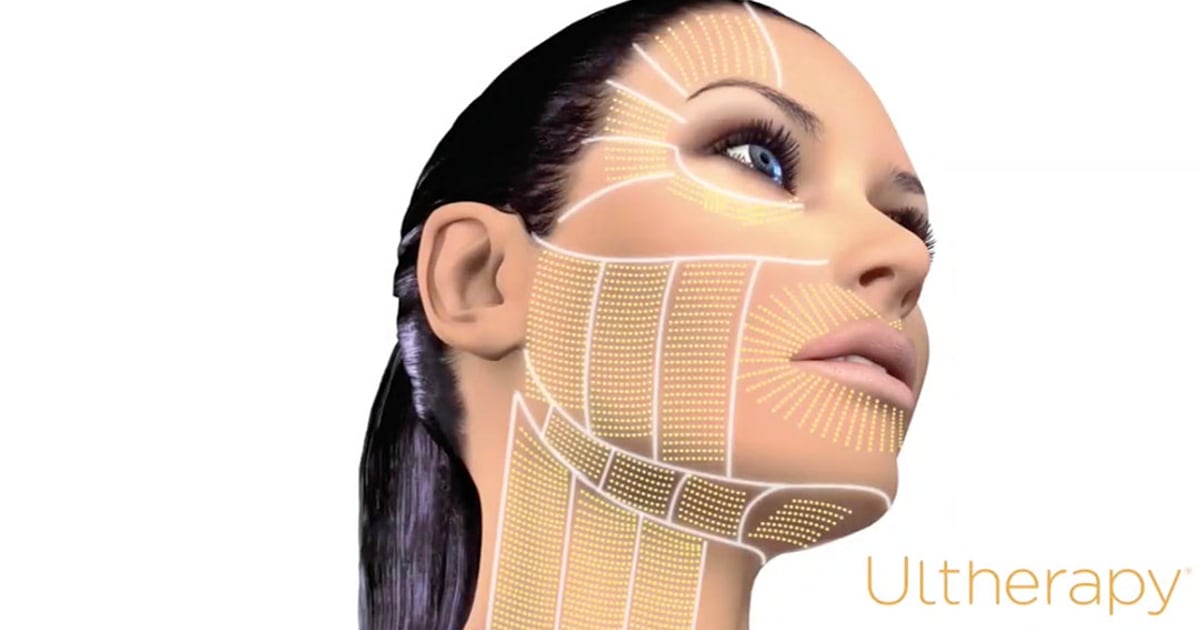
Ultherapy itself treats the face and the body: the forehead, the brow, the temples, the cheeks, the jawline, under the chin, the neck, the chest, and loose skin on the arms, the abdomen and the knees.
What one session looks like
In our experience a full face and neck takes 60 to 90 minutes, and most people go back to work the same day, with some redness for a few hours. The lift builds over three to six months and we compare your photographs at three months, and in our experience it holds for around a year. A 2019 consensus of five experts advises that the interval between treatments be tailored to age, and in our practice a repeat is considered after 12 to 18 months. The how long it lasts and can it go wrong pages cover the months after and the side effects.
Book a free consultation
Call Ultherapy London on 0207 043 8109 or use the form below. The clinician examines your skin, tests how it springs back, goes through your health and your medicines, and tells you whether Ultherapy, another of our treatments or a combination suits you, with the price per area in writing. The consultation and every follow-up review are free. The full Ultherapy guide covers the rest. Our patients review the clinic on review.clinic, where it scores 4.9 out of 5 from 49 reviews in November 2026.
